


Key Takeaways
- MSCI’s simulated index deletions embrace Strategy, Metaplanet and Yellow Cake.
- JPMorgan estimated MSCI removing may set off $2.8 billion in Strategy promoting.
- Bitcoin Policy Institute says MSCI expects a call by Oct. 16.
Wall Avenue’s Quiet Committee Can Transfer Billions
Your “passive” index fund isn’t fairly as passive because the label suggests. Someplace upstream, a personal index supplier writes the principles deciding which firms rely because the market, and people selections can ship funds scrambling to purchase or promote billions of {dollars} in shares.
On Wednesday, the Washington, D.C.-based, non-partisan, non-profit suppose tank, Bitcoin Policy Institute, took the wraps off that machinery in a new paper by Government Director Conner Brown, specializing in MSCI’s proposed take a look at for “non-operating firms.” MSCI’s personal simulation, in accordance with the paper, would take away Strategy, Metaplanet, and Yellow Cake, an organization holding bodily uranium.
Passive Cash Nonetheless Has Somebody Choosing the Record
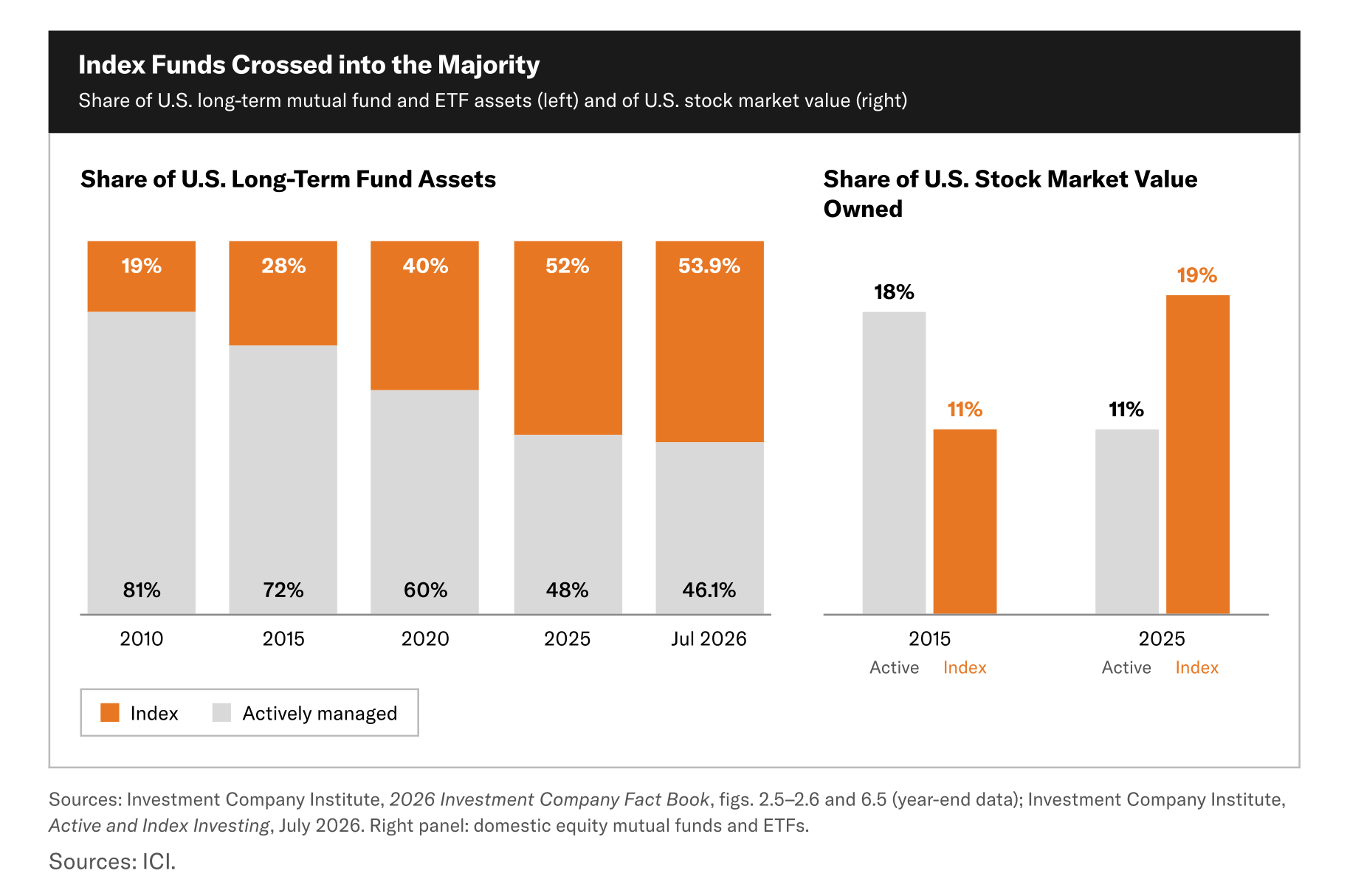
Brown’s paper on the subject places some eye-popping numbers behind the ability wielded by index suppliers. As of July, index funds held $21.8 trillion, or 53.9% of U.S. long-term fund belongings, versus $18.6 trillion in actively managed funds. By 2025, index funds owned 19% of the U.S. inventory market. MSCI alone says $21 trillion is benchmarked to its indexes, together with $2.8 trillion in fairness exchange-traded funds that monitor them immediately.
That results in one of many extra counterintuitive factors in Brown’s analysis. The index supplier doesn’t truly handle these trillions. Fund managers do. But when an index supplier modifications the businesses on its checklist, funds constructed to trace that benchmark typically have to regulate with it. As Brown’s evaluation lays it out, the agency writing the rulebook by no means touches the investor’s cash, however its selections can nonetheless set billions of {dollars} in movement.
The mechanics grew to become significantly much less theoretical in 2025. The Bitcoin Policy Institute creator recounts how MSCI proposed excluding firms whose digital belongings represented at least 50% of whole belongings, placing the bitcoin treasury firm Strategy squarely within the body. JPMorgan analysts estimated Strategy’s removing may immediate roughly $2.8 billion in promoting by MSCI-tracking funds, climbing to $8.8 billion if different index suppliers adopted.
MSCI finally nixed the proposal, however Brown factors to what occurred subsequent. The agency froze will increase within the variety of shares it might rely for affected firms and deferred new additions whereas making ready a broader evaluate.
Bitcoin Rule Returns Carrying a Completely different Hat
Seven months later, Brown writes, MSCI got here again with a broader take a look at that not singled out bitcoin (BTC) or digital belongings by title. As an alternative, the August proposal facilities on whether or not an organization has sufficient “working belongings.” An organization failing the preliminary 50% display screen faces 5 further monetary exams and, if it isn’t already an index constituent, may be excluded after triggering 4 of them. Current constituents obtain buffers and customarily should fail throughout two consecutive annual opinions earlier than removing.
Right here’s the place Brown sees a basic downside. His paper says “working belongings” isn’t a standardized balance-sheet class beneath U.S. GAAP or IFRS, leaving MSCI to classify all the pieces from money and mineral rights to unfinished building, mental property and strategic holdings earlier than the maths may even start.
Brown additionally zeroes in on Strategy’s bitcoin accounting. The corporate reported $22.8 billion in bitcoin-related working losses throughout the first half of 2026, in contrast with $195 million in its different working bills. Depend these figures as Strategy filed them, Brown argues, and one in all MSCI’s flags wouldn’t be triggered. The 23-page paper contends that reaching MSCI’s simulated outcome, due to this fact, requires an analytical reclassification that the session doesn’t disclose.
The Uranium Twist Breaks the Story Broad Open
Brown’s argument will get significantly stranger as soon as bitcoin leaves the image. MSCI’s simulated deletions also include Yellow Cake, an organization that holds bodily uranium. The Bitcoin Policy Institute paper then takes the proposed methodology for a spin throughout different capital-intensive companies, illustrating how the identical logic would possibly attain firms constructing satellites or a significant U.S. lithium mine.
Beneath one believable interpretation examined by Brown, AST Spacemobile may set off 4 of MSCI’s flags and doubtlessly be barred as a brand new index entrant. Lithium Americas presents an excellent sharper instance. The corporate is building the Thacker Pass lithium project in Nevada, and Brown’s evaluation finds it may additionally set off 4 flags.
Lithium Americas reported $3.54 billion in belongings in June, together with $2.09 billion in mineral properties, plant and gear. But Brown’s paper exhibits how a restrictive studying of MSCI’s proposal may make a mine nonetheless beneath building look “non-operating” exactly as a result of it’s costly to construct, hasn’t begun producing income and relies upon closely on exterior financing. The larger the unfinished undertaking, in different phrases, the stranger the accounting image can grow to be.
MSCI is expected to decide on or earlier than Oct. 16, with any adopted modifications slated for its November index evaluate round Dec. 1. Brown’s paper begins with bitcoin treasury firms, however its argument in the end lands someplace a lot larger. When trillions of {dollars} mechanically comply with an index, the definition of what counts as an working enterprise is something however educational.