
The collapse of Paraguay’s digital lender Ueno Bank final week left practically three million prospects — roughly 60% of Paraguay’s adults — unable to entry their accounts.
Paraguay’s Central Bank placed Ueno into decision on Nov. 3 after its solvency ratio fell under half the legally required minimal. An investigation uncovered questionable lending practices and deficiencies in credit score documentation and accounting.
The collapse additionally triggered a political disaster, with hundreds taking to the streets to protest and President Santiago Peña attempting to resign earlier than being impeached and arrested on costs of breach of belief and utilizing his workplace for private achieve.
Paraguay’s peer-to-peer crypto market instantly mirrored the turmoil, with some sellers asking for a USDt premium of as much as 13%. “USDt is a lifeline for a whole bunch thousands and thousands of individuals on the planet,” Tether chief govt Paolo Ardoino said.
For a lot of, the incident sparked uncertainty over financial savings, wages and the cash wanted to cowl on a regular basis bills. With the native guaraní (PYG) foreign money falling 12.3% in per week, some turned to stablecoins to take care of the worth of their funds, or simply to maintain funds shifting alongside.
David Eisenmann, founder and chief govt of Paraguayan crypto alternate X4T, tells Journal the timing made the liquidity want much more pronounced.
“The intervention got here within the first days of the month,” he says, “precisely when salaries, hire and provider invoices are due,” including that many enterprise house owners “couldn’t make payroll.” For some, USDt was “abruptly probably the most liquid cash” they’d:
“This week they discovered that having an account isn’t the identical as accessing your cash.”
However past one other TradFi masterclass within the virtues of self-custody, Ueno’s collapse highlights the rising function of dollar-pegged stablecoins offering another supply of liquidity when conventional banks fail.
Crypto as a supply of liquidity
Eisenmann says X4T processed greater than $10 million in native on-ramp quantity over the 30 days to early November, however a few of that exercise predated Ueno’s collapse.
“The greenback started recovering towards the guaraní in October,” he says, “and the Ueno information sped up a transfer that was already underway.”
Associated: Stablecoins can drain from banks and nations at lightning speed
He says the exercise “runs in each instructions,” with some prospects promoting crypto for guaraníes or {dollars} to cowl funds they may not make by Ueno, whereas “demand for USDt and USDC as a greenback retailer of worth has risen sharply.”
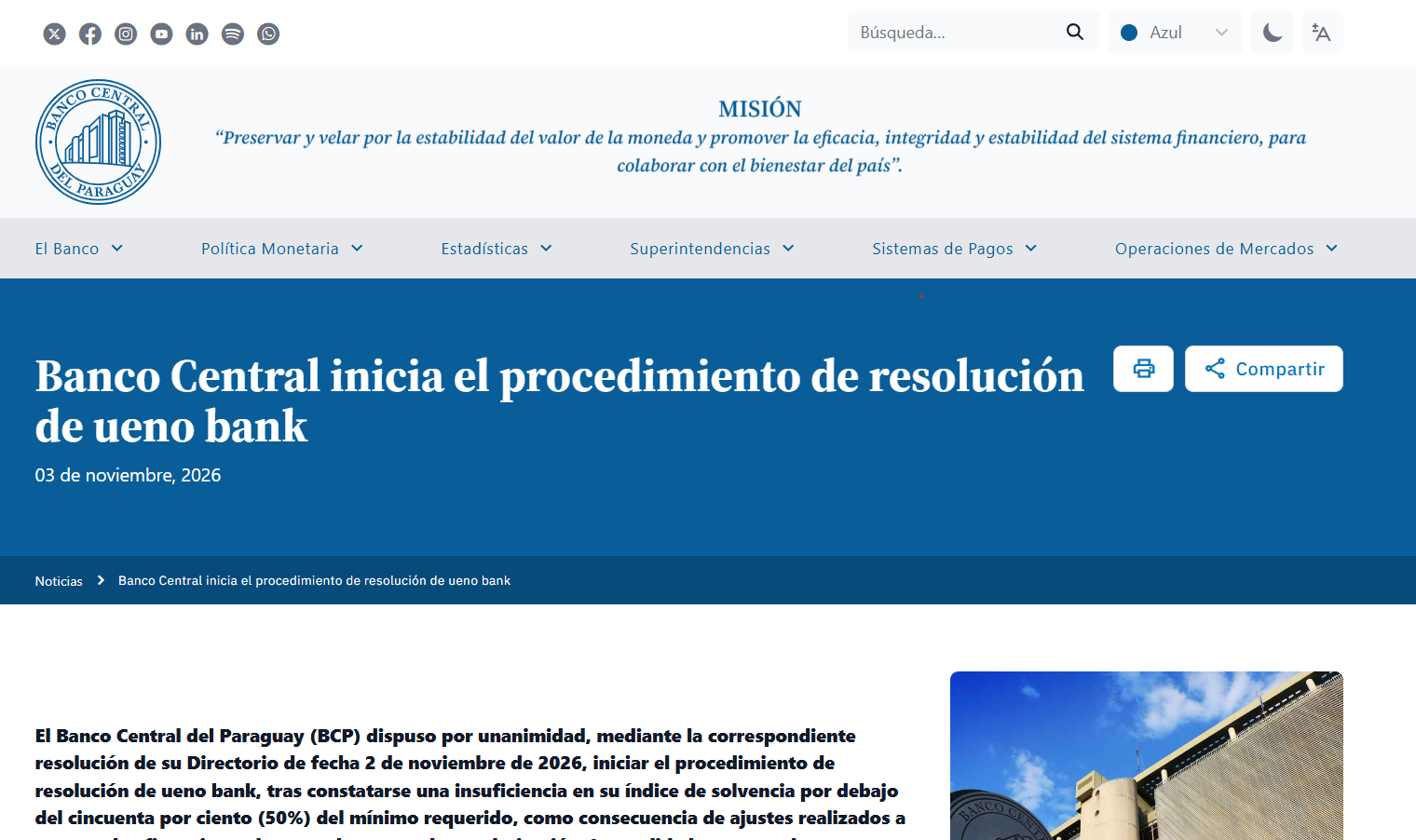
Paraguay’s Central Bank positioned Ueno into decision on Nov. 3. Supply: Central Bank of Paraguay
As of Nov. 9 the Central Bank said 93.1% of consumers with Ueno deposits had been repaid. Regardless of this confidence has been shaken and X4T continued to see larger on-line inquiries for dollar-denominated stablecoins. In actual fact, Eisenmann says the extent “has not modified considerably” from the week of the collapse.
Rhys Hicks, affiliate analyst at knowledge and analytics firm GlobalData, says the digital financial institution’s failure has proven “how a lot can go incorrect when governance doesn’t preserve tempo with progress.”
That mentioned, he’s not seeing proof of a mass migration from Paraguayan banks into stablecoins, since different banks “picked up the slack,” and folks “appear to have been angrier” with the federal government than with the banks.
“Some customers will search for other ways to maintain their cash protected, however I don’t see an awesome shift to stablecoins but,” he says.
An previous impulse, with new rails
Looking for {dollars} when confidence in home banks falters is hardly new. In Argentina’s 2001 monetary disaster, the federal government imposed the “corralito,” proscribing money withdrawals from financial institution accounts, following a run on deposits.
Associated: Peter Thiel backs crypto-friendly Silicon Valley Bank rival — Report
Amid a deepening disaster over the nation’s foreign money peg and sovereign debt, the federal government later transformed dollar-denominated deposits into pesos, decreasing individuals’s financial savings by about 30% in a single day and additional damaging confidence within the nation’s fraying banking system.
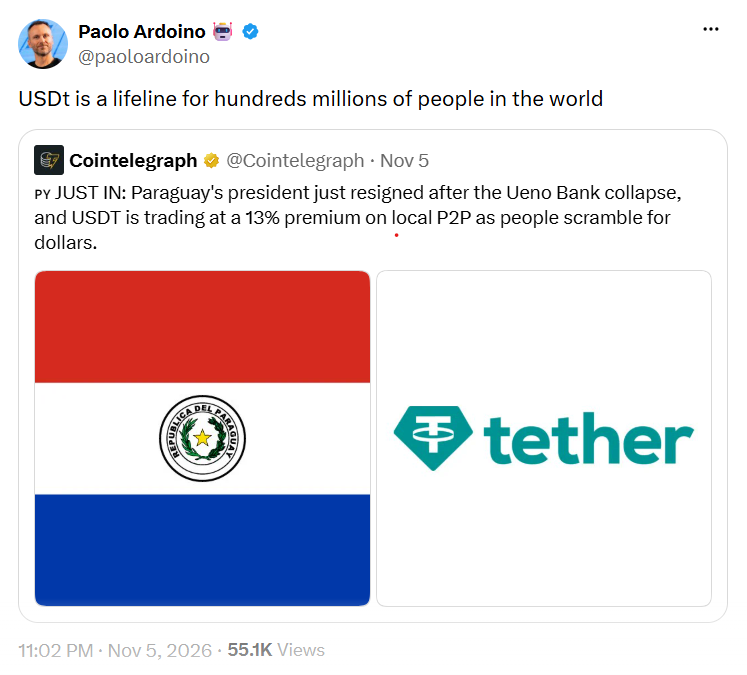
Tether CEO calls USDt a lifeline. Supply: Paolo Ardoino
However stablecoins aren’t decentralized and they don’t seem to be insulated from the banking system both.
In the course of the March 2023 collapse of Silicon Valley Bank, stablecoin issuer Circle disclosed that $3.3 billion of USDC reserves, round 8% of the entire, had been held on the lender. USDC briefly depegged and fell to 86 cents on secondary markets after Circle mentioned it couldn’t withdraw the funds.
A BIS paper on stablecoins and the worldwide financial system warns that widespread use of dollar-backed tokens might create challenges for financial sovereignty in rising markets.
Hicks says stablecoins can present another during times of political instability and “low belief within the native system” as a result of they’re pegged to a extra secure foreign money, just like the US greenback.
However regulators want to handle “transparency” and “client safety,” he says, as a result of stablecoin holders don’t profit from the identical deposit ensures as financial institution prospects, and there’s no central financial institution to step in and make them entire.
Eisenmann says he expects the incident to spark extra “diversification,” with individuals “spreading their cash throughout banks, money and digital belongings” as a substitute of counting on a single establishment.
“How rapidly belief within the banks returns will rely on how rapidly and transparently the authorities deal with the decision,” he says.
Journal: What Democrats’ US midterm sweep means for the CLARITY Act