


If you promote a share in a staking Ethereum ETF, the client pays for it even when a number of the ETH backing the fund continues to be dedicated to validating transactions on the community.
You can go away the funding whereas these cash preserve incomes rewards, as a result of promoting a share transfers your curiosity to a different investor with out requiring the fund to withdraw the ETH.
Massive establishments, however, have one other means out: they can return shares on to the fund in alternate for money or property, relying on the product’s phrases.
That course of helps preserve share costs near the worth of the holdings, but it turns into a lot tougher to handle when a fund must ship cash that Ethereum hasn’t but launched from staking.
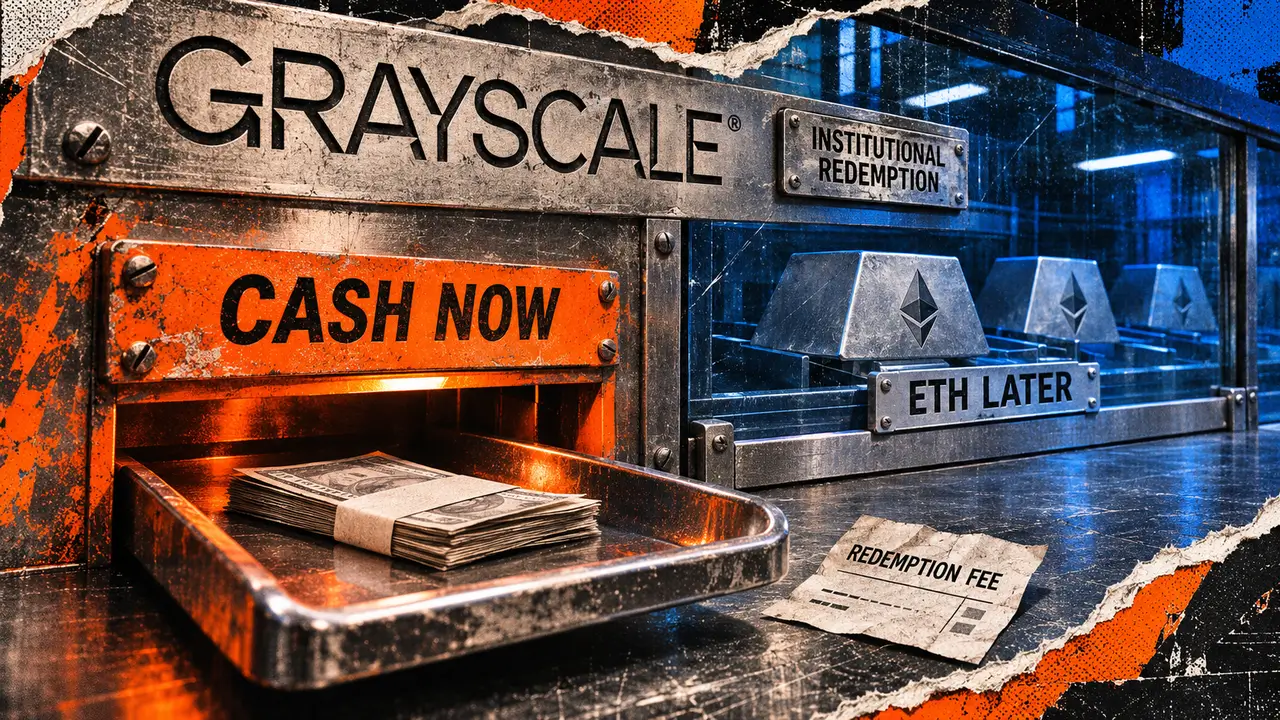
If an surprising scarcity exhausts the fund’s unstaked reserve, a firm providing staking Ethereum ETFs like Grayscale can prepare for a collaborating buying and selling firm to produce {dollars} for a money redemption and obtain the ETH later, paying the redeeming establishment whereas the cash work their means by means of withdrawal.
The corporate earns an upfront payment and bears the distinction between the ETH’s value on the commerce date and its value at supply, although it could hedge that publicity.
The phrases appear in a filed liquidity-provider settlement that turns a network-imposed wait into an expense the events can conform to finance.
For investors comparing Ethereum ETFs, the association affords a strategy to look past staking yield alone: funds holding the identical asset can depend on completely different establishments, with completely different obligations, to maintain redemptions shifting.
Who pays when an Ethereum ETF has to attend for ETH
Approved members, normally a broker-dealer, redeem by returning a giant block of shares known as a basket.
In an ordinary Grayscale cash redemption, a liquidity supplier provides the {dollars} and receives ETH from the fund, which usually makes use of cash it has saved out of staking. That unstaked reserve permits investors to depart with out the fund having to provoke a validator exit for each redemption.
Maintaining more ETH available reduces the proportion incomes staking rewards, so the sponsor has to steadiness income towards the property it could want to maneuver promptly.
Even when it requests a withdrawal, the fund should wait for Ethereum’s exit and withdrawal procedures earlier than the cash change into transferable.
Grayscale’s April disclosure for its flagship Ethereum ETF (ETHE) restricts delayed supply to an unexpected, atypical liquidity occasion that exhausts the unstaked reserve, and solely till that reserve is replenished.
As soon as a collaborating firm accepts such an order, it provides the money whereas the fund owes the designated ETH on the primary enterprise day these specific cash change into transferable, even when different ETH turns into obtainable sooner.
The redeeming dealer pays the payment, which compensates the buying and selling firm for the anticipated wait and stays mounted as soon as agreed.
The Mini ETF’s Nov. 19 submitting describes the identical cash-first sequence and specifies that neither aspect receives an adjustment if the precise supply date differs from the estimate. An extended wait can tie up the corporate’s cash and hedges for longer with out incomes it extra compensation underneath that order.
The dealer pays a mounted payment; the buying and selling agency provides money now and accepts supply of designated ether later.
ETHE’s April disclosure restricts use to an unexpected, atypical occasion that exhausts the unstaked reserve, till replenishment. Solely collaborating corporations can settle for orders. The reviewed filings don’t establish a accomplished order or combination dedicated capability.
The corporate can account for that risk in its preliminary quote, and the cost of accepting a new order can differ from the cost on an present one.
Nonetheless, just some suppliers have agreed to delayed supply, and Grayscale’s disclosure affords no assurance that these preparations will provide sufficient liquidity.
An in a single day mortgage covers a completely different delay
BlackRock and Morgan Stanley disclose financing that lets a fund transact whereas ETH strikes from custody to a buying and selling account.
Based on BlackRock’s ETHB prospectus, motion out of custody can take as much as 24 hours or longer. The corporate stated Coinbase Credit score provides property or money for trades within the meantime.
The fund typically has to repay these commerce credit by 6 p.m. New York time on the following enterprise day, with availability depending on the lender having the required sources and the settlement’s different circumstances.
Morgan Stanley’s MSSE prospectus sets a common compensation deadline of 6 p.m. on the following day, together with weekends, and in addition contemplates separate liquidity preparations.
A validator withdrawal can outlast these routine credit, so an in a single day facility alone would not set up that a fund can finance an prolonged staking exit.
 How a lot Ethereum every fund held exterior staking
Share of every fund’s whole Ethereum holdings exterior staking on Sept. 30. ETHE is calculated from staked and whole ETH honest values and rounded to 1 decimal, whereas the opposite shares equal 100% minus the reported staked share.
 CryptoSlate
Some unstaked cash could already be wanted for different orders or distributions, and a single day’s steadiness can differ significantly from a fund’s common combine. For instance, TETH ended September with 50.9% staked, whereas its every day staked share averaged 76.05% throughout the quarter.
The bigger reserve at quarter-end would not inform us what was obtainable all through these three months or how a lot exterior financing the fund could receive.
BlackRock’s redemption provisions for its Ethereum ETF describe the fund’s capability to delay settlement or use completely different redemption procedures in specified circumstances.
The payment can enter the value you obtain
Suppose an establishment can purchase a basket’s price of shares for $998,000 and redeem it for $1 million earlier than prices. It has $2,000 to cowl execution and financing, together with safety towards value actions.
If these bills whole $1,000, the commerce leaves $1,000 earlier than different prices; if an anticipated delay lifts them to $3,000, shopping for at the identical value would lose cash.
The establishment would possibly then bid much less for the shares or go on the commerce, relying on the alternate options obtainable. Shareholders promoting into that decrease bid would obtain much less, although the approved participant pays the contractual redemption payment.
Competitors between buying and selling corporations can restrict how a lot of that cost reaches investors, but assigning a payment to the dealer would not cease corporations from incorporating it into their costs.
Nonetheless, that is a hypothetical calculation, not proof that staking has prompted a particular Ethereum ETF discount.
Spreads and reductions can transfer for different causes, and measuring a shareholder’s cost would require contemporaneous quotes and a comparable internet asset worth. The instance exhibits how redemption phrases can have an effect on a vendor earlier than any underlying cash are delivered.
Redemption prices can erase a $2,000 hole
Hypothetical basket: purchase ETF shares for $998,000 and redeem for $1,000,000 earlier than prices. The $2,000 gross distinction leaves a $1,000 revenue with $1,000 of execution, financing, and hedging prices. Breaks even at $2,000, and turns into a $1,000 loss at $3,000.
CryptoSlateGrayscale has already distributed staking proceeds in cash, giving shareholders a seen return from placing ETH to work.
Its delayed-delivery contract describes an expense on the opposite aspect of that income: when the fund wants {dollars} earlier than the designated cash can be found, a buying and selling firm has to agree to produce them.
The payment pays that firm to attend, whereas the dealer shopping for shares has to depart room for the invoice within the value it affords the departing shareholder.